

Call for a Swift Transition to Renewable Energy to Protect Rivers, Water and Nature
Dhaka, 26 September 2026: Environmental and river experts have called for a swift transition to renewable energy by reducing dependence on fossil fuels to protect rivers and water resources. They said sustainable energy systems are crucial for protecting rivers, water, forests and aquatic ecosystems, as well as addressing the impacts of climate change.
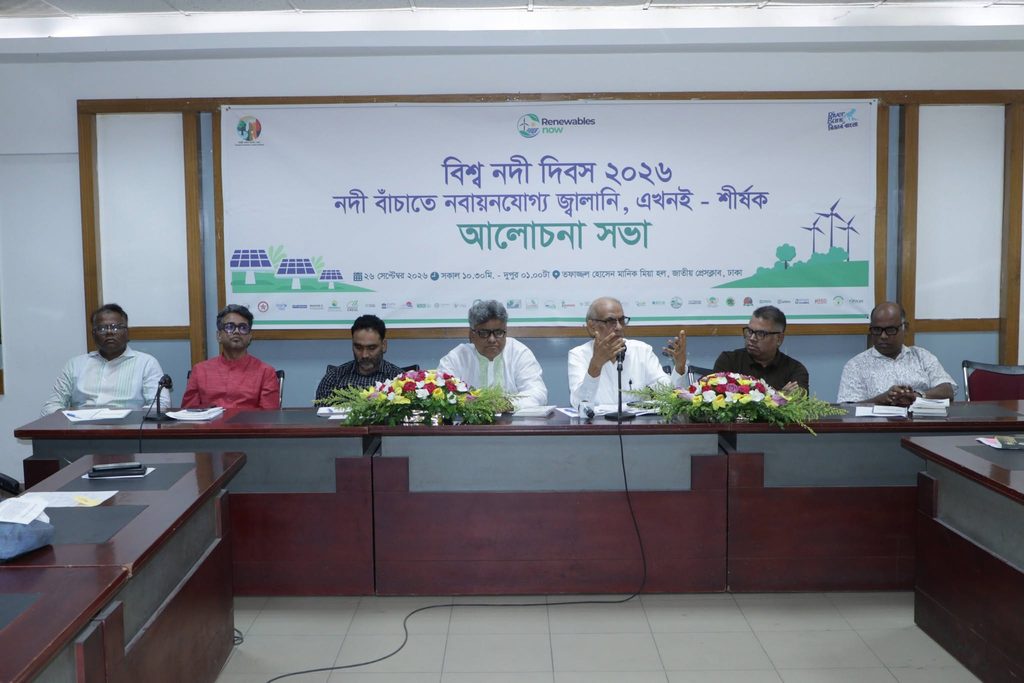
Marking World Rivers Day 2026, a discussion titled “Renewable Energy, Now, to Save Rivers” was held on Saturday, 26 September, at the Tafazzal Hossain Manik Mia Hall of the National Press Club. The event was organised by Dhoritri Rokhhay Amra (DHORA) and River Bangla, with support from 35 other organisations. The discussion was chaired by Dr. Mujibur Rahman Howlader, former Chairman of the National River Conservation Commission and Member of DHORA’s Advisory Council. Md. Iqbal Faruk, Head of Research at Waterkeepers Bangladesh and Member of DHORA, delivered the welcome remarks, while Faisal Ahmed, Editor of River Bangla, moderated the session.
Dr. Mujibur Rahman Howlader said that rivers are public property and national resources of Bangladesh. He stressed that protecting people, biodiversity and civilisation is impossible without safeguarding river flows and water bodies. He called for a planned and phased transition to renewable energy, alongside integrated and scientific research on river management, effective measures to free rivers from encroachment, and restoration of river flows.
Journalist and writer Amin Al Rashid, journalist, writer and researcher Dr. Kajal Rashid Shaheen, and river researcher and Secretary General of Riverine People Sheikh Rokon spoke at the discussion. They highlighted the impacts of the energy system on rivers and the environment and called for increased use of renewable energy, sustainable implementation, and a shift towards environmentally responsible energy systems instead of harmful energy sources and unnecessary mega-projects.
Md. Iqbal Faruk said fossil fuel-based power plants are harming river health, biodiversity and fisheries. He emphasised the need for a planned fossil fuel phase-out and greater deployment of renewable energy, including solar power, instead of coal-fired power plants. Pashur River Waterkeeper Nur Alam Sheikh also called for a sustainable and just energy transition to protect rivers, forests and water resources.
The discussion highlighted the impacts of fossil fuels on rivers and aquatic ecosystems, climate-related risks, and the need and potential for transitioning to renewable energy to protect rivers and water resources. A total of 37 organisations joined DHORA and River Bangla in the joint initiative.
A Collaboration of total 37 civil and social organisations:
Dhoritri Rokhhay Amra (DHORA), Bengal Peace Foundation, Waterkepers Bangladesh (WKB), Centre for Atmospheric Pollution Studies (CAPS), Youth Action for Social Development (YASD), Apos Youth Organisation, Brighters, Youth Environment and Development Organisation (YEDO), OAB Foundation, River Bangla, Taranga Foundation, Climate Frontier (CF), Dream Research and Development Foundation (DRDF), Bangladesh Krishok Federation (BKF), Riverine People, Environmental Research and Development Alternatives (ERDA), Sundarbans and Coastal Protection Movement, Sachetan Nagorik Samaj Organisation, Coast Foundation, Center for Participatory Research and Development (CPRD), Center for Renewable Energy Services Limited (CRESL), Earths Ants, Kasmas Organization, BARCIK, Haor Region Dwellers, Shopner Shiri Social Welfare Organisation, Mission Green Bangladesh (MGB), Equity BD, Sachetan Foundation, Sampriti O Souhardya, Gorjon Social Welfare Organisation, Bangladesh Sustainable and Renewable Energy Association (BSREA), River Social Development Bangladesh, Greenway Renewable Energy Implementation Organisation, UNIVO, YouCan, and Greenpeace Youth Development Society.