

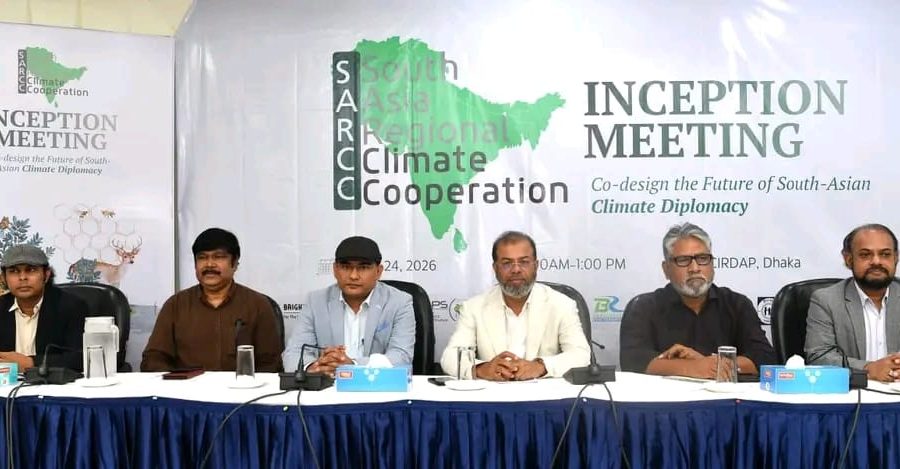
24 August 2026, Dhaka: The need for stronger regional cooperation, political commitment, and coordinated climate diplomacy among South Asian countries to address shared climate risks was highlighted at the inaugural meeting of the South Asia Regional Climate Cooperation (SARCC).
Held on 24 August 2026 at the CIRDAP Auditorium in Dhaka, the inception meeting was themed “Co-Design the Future of South Asian Climate Diplomacy.”
The event was attended by Dr. Md. Saimum Parvez, Special Assistant to the Prime Minister on Environment, Forest and Climate Change, and Sheikh Faridul Islam, MP, State Minister for Environment, Forest and Climate Change. The keynote paper was presented by Professor Dr. A. K. M. Saiful Islam of Bangladesh University of Engineering and Technology (BUET).
Among the special guests were Jamail Bashir JB, member and technical expert of the National Tree Plantation Cell at the Prime Minister’s Office; Sharif Jamil, Coordinator of Waterkeepers Bangladesh and Member Secretary of Dhoritri Rokhhay Amra (DHORA); Ziaul Haque, Coordinator of the Least Developed Countries (LDCs) Group of Negotiators; and climate negotiator M. Hafizul Islam Khan. Senior journalist Habib Rahman was also present.
Thematic discussions featured Advocate M. A. Mukit, Chairman of the Human Safety Foundation; Mir Mohammad Ali, Assistant Professor at Sher-e-Bangla Agricultural University; Md. Ashrafuzzaman Khan, Climate Change Programme Coordinator at CCDB; Sarwar Alam Dipu, Programme Manager at IUCN Bangladesh; Mahmudul Hasan Tarek, Head of the Water, Food and Climate Programme at Helvetas Bangladesh; Sharmin Nahar Nipa, Assistant Director of the Centre for Climate Change and Environmental Research at BRAC University; and Professor Dr. Kamruzzaman Majumder, Chairman of the Center for Atmospheric Pollution Studies (CAPS).
Participants emphasised the importance of revitalising regional platforms such as SAARC and BIMSTEC to address shared climate vulnerabilities across South Asia. They also called for joint research, information sharing, and coordinated policy initiatives to strengthen regional climate action and diplomacy.


